Home Page     Kingdom Index      Plant Index     Liliopsida Index      Melanthiaceae Index


Anticlea elegans (Pursh) Rydb.
This beautiful but poisonous plant is known as the "mountain death camas".


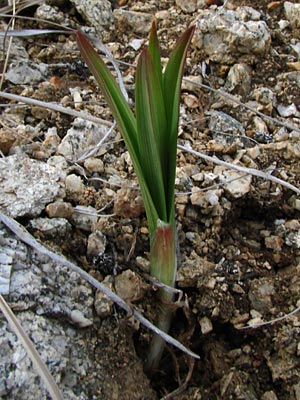
1.  Mid-May photo taken just after the leaves
emerge.  Already we see tinges of red on the
leaf tips and on the sheath at the base of
the plant.
Download Large Photo


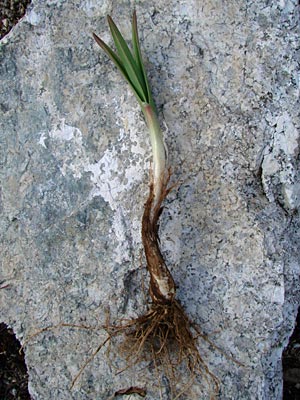
2.  Plant in photo at left after being dug out
of the rocks and soil.  The tunicate bulb is
layered like an onion. The outer layer
is fibrous.
Download Large Photo


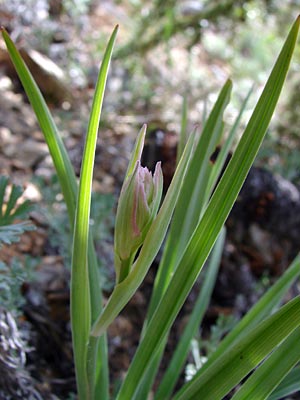
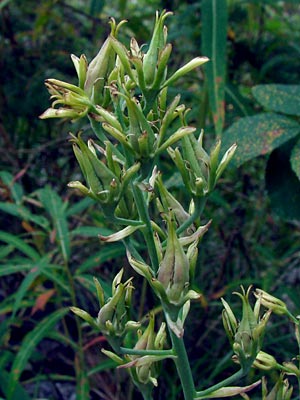
3.  Photo taken in mid-June.
The flower stalk is just emerging and
appears pink due to the bracts which protect
the individual buds.
Download Large Photo


4.  Closer view of emerging flower stalk
Download Large Photo


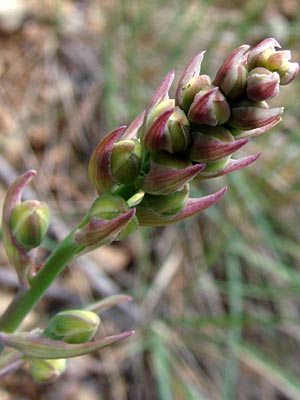
5.  Late June.  The individual buds with their
bracts appear.  The flower stalk will elongate.
Download Large Photo


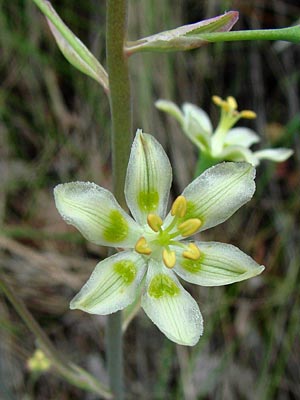
6.  Late June.  The anthers have appeared along
with the tepals which make up the perianth.
Download Large Photo


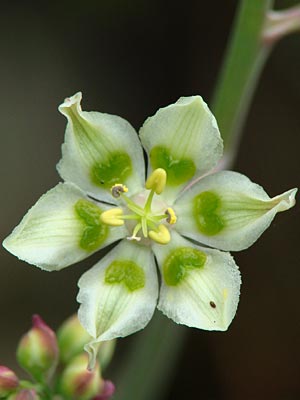
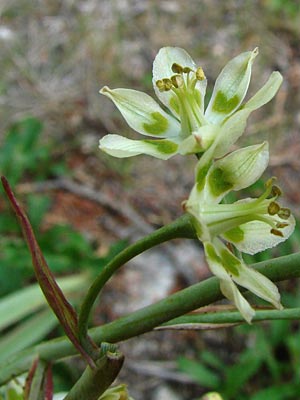
7.  Late June.  Good view of the pairs of
nectary glands at the base of the tepals which
are characteristic of the genus.
Download Large Photo


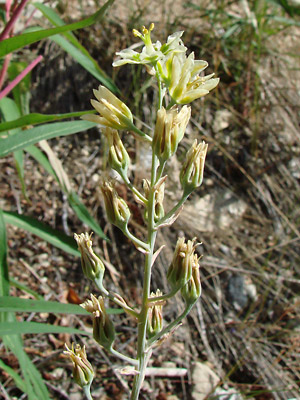
8. Late June. view of the raceme with
side views of the individual blossoms.
Note the bracts at the base of the flower stalks.
Download Large Photo


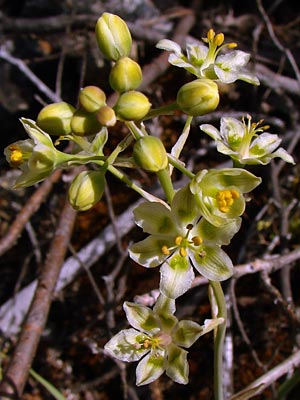
9.  Late June.  Buds and blossoms with
anthers at various stages of development.
Download Large Photo


10.  Early July.  Two blossoms with the
stamens shielding the ovary.
Download Large Photo


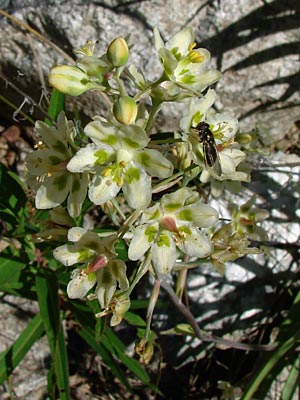
11. Mid-July.  Centers of some blossoms are
now pink.  Some buds are still undeveloped.
Download Large Photo


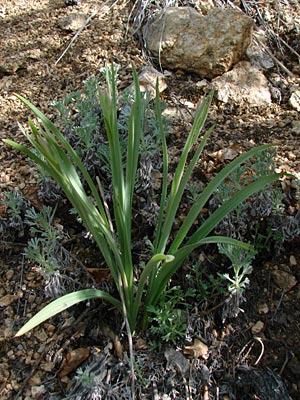
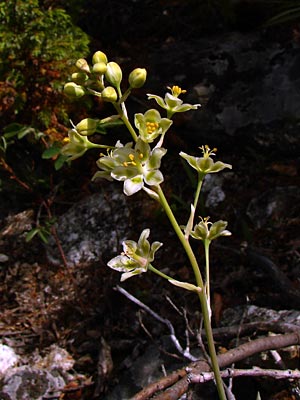
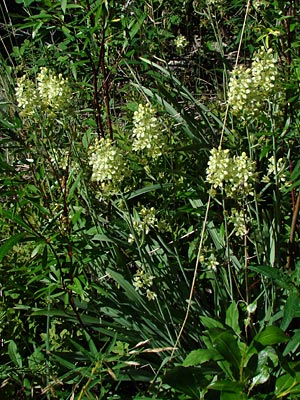
12.  Mid-July  A cluster of death camas
showing the long flower stalks.
Download Large Photo


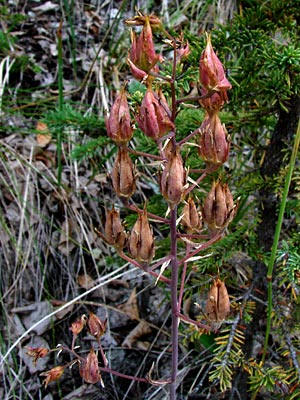
13.  Mid-August.  The tepals are gone and
the seed capsules have developed.
Download Large Photo


14.  Mid-August.  This raceme located within
ten feet of the one on the left has turned red.
Download Large Photo